 DeLand One
The Story of DeLand
In 1876, Henry A. DeLand, a baking soda manufacturer from Fairport, New York, visited a settlement known as Persimmon Hollow and bought land there. On December 6, 1876, settlers met in John Rich's log cabin and voted to name the community DeLand. The town was incorporated in 1882.
Citrus groves drew new families, and the academy DeLand founded in 1883 grew into Stetson University. In September 1886 a fire destroyed much of the business district on Woodland Boulevard, and the town rebuilt it in brick. DeLand became the Volusia County seat in 1888, and its historic downtown still lines the boulevard today.
Chapter 1 · 1846–1882
From Persimmon Hollow to DeLand
Long before there was a town, Native peoples lived along this stretch of the St. Johns River and left behind shell mounds, pottery and tools. The first settler was probably Ruben Marsh, who had scouted in the Seminole War. He moved here in 1846, built a cabin and raised cattle. Settlers called the place Persimmon Hollow, after the wild persimmon trees that grew around its natural springs.
In 1874 Captain John Rich built a log cabin on what is now West New York Avenue. Two years later, in 1876, Henry Addison DeLand arrived. He was a baking soda manufacturer from Fairport, New York, and he came inland with his brother-in-law, O. P. Terry, who had caught Florida's "orange fever." DeLand bought a homestead of about 160 acres and pictured a community built around citrus, education and culture.
On December 6, 1876, DeLand called the nearby settlers together in the Rich cabin, and they voted to name the community after him. He hired people to clear land and lay out streets, and he recruited settlers, many of them from upstate New York. He never lived in the town year-round.
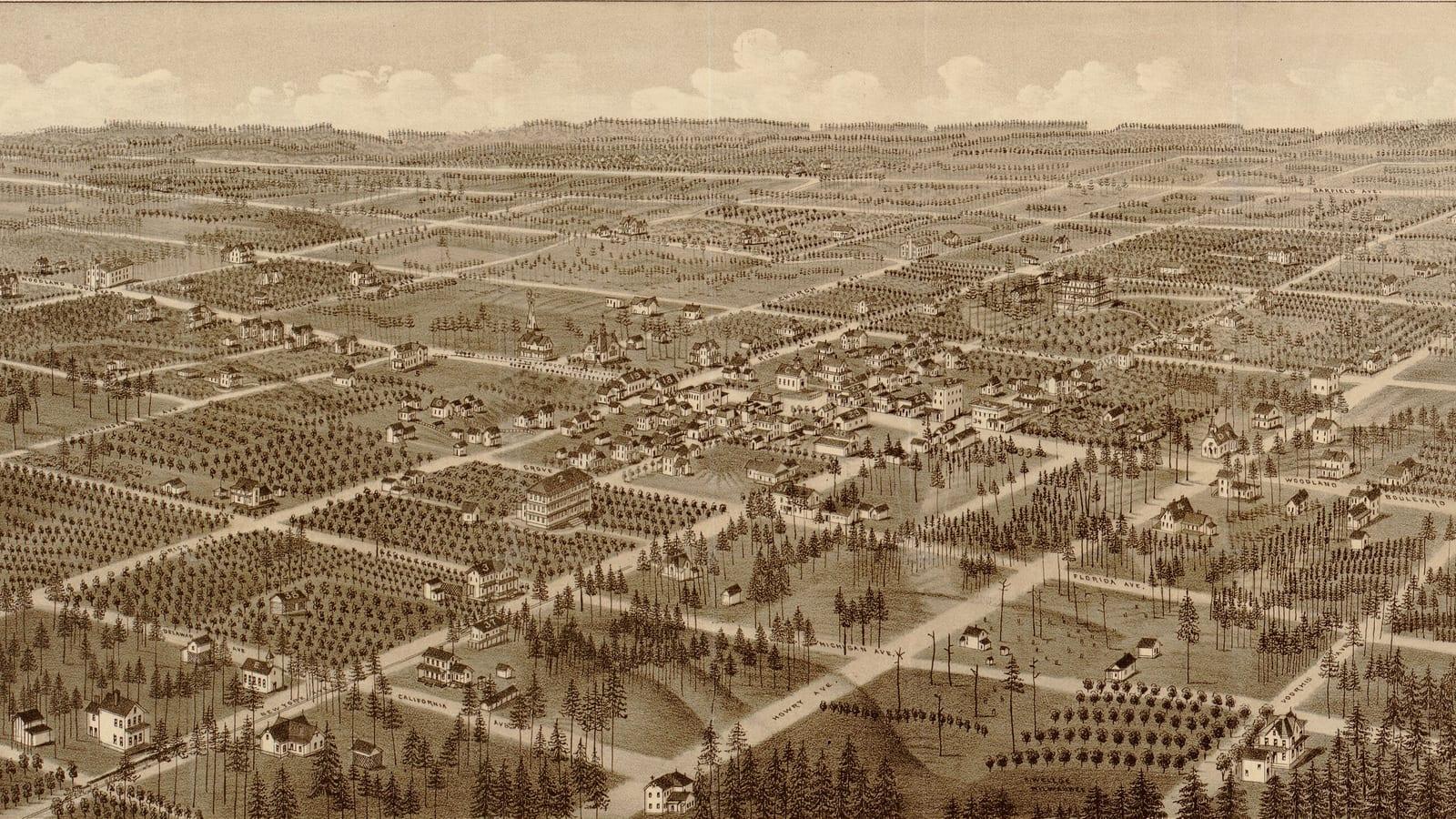
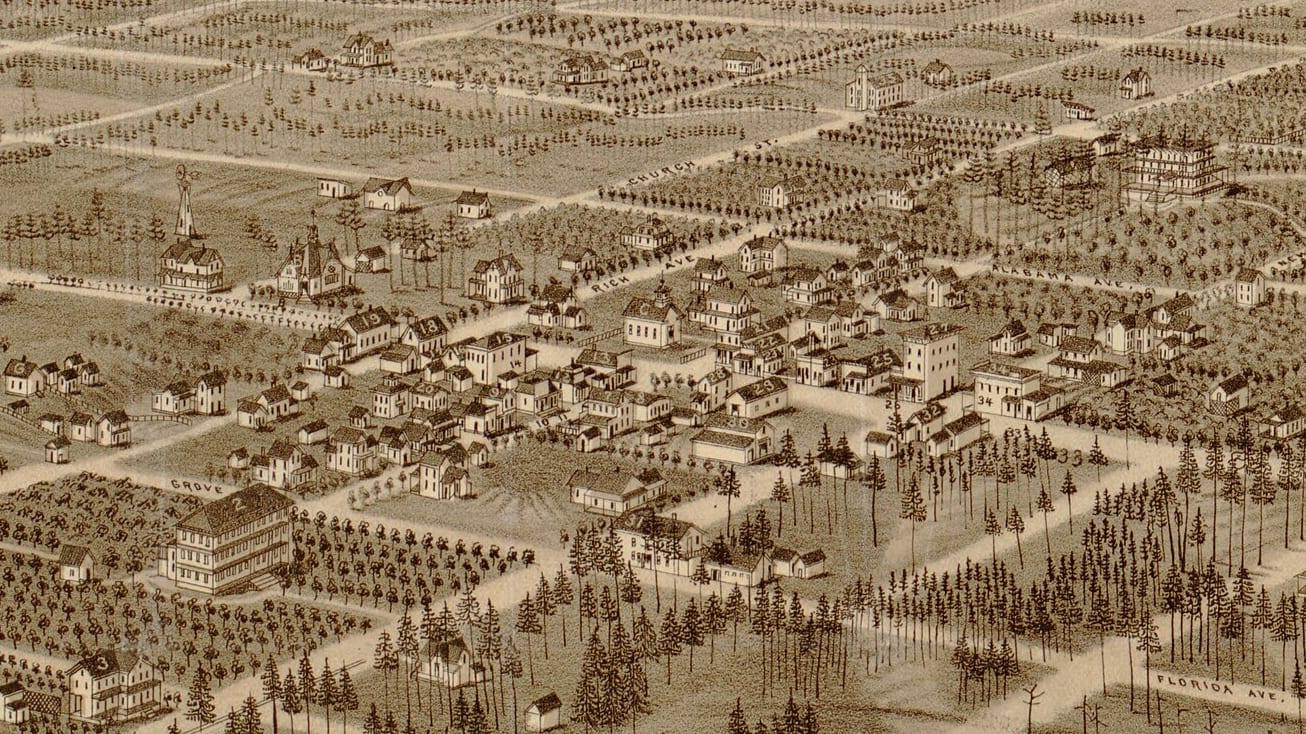
In its early years the town could be reached only by steamboat up the St. Johns River. It grew quickly, and in 1882 DeLand was incorporated as a town. A bird's-eye map printed in 1884 shows its new streets, homes and groves.
Sources
Chapter 2 · 1880s–today
Woodland Boulevard, then and now
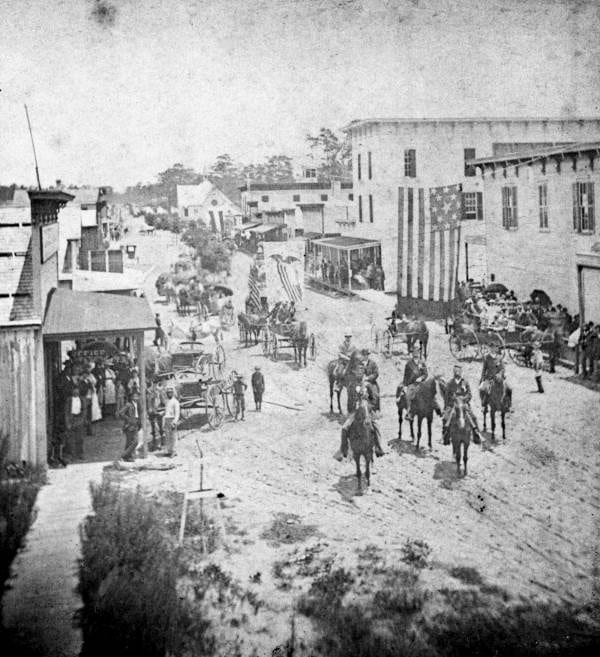
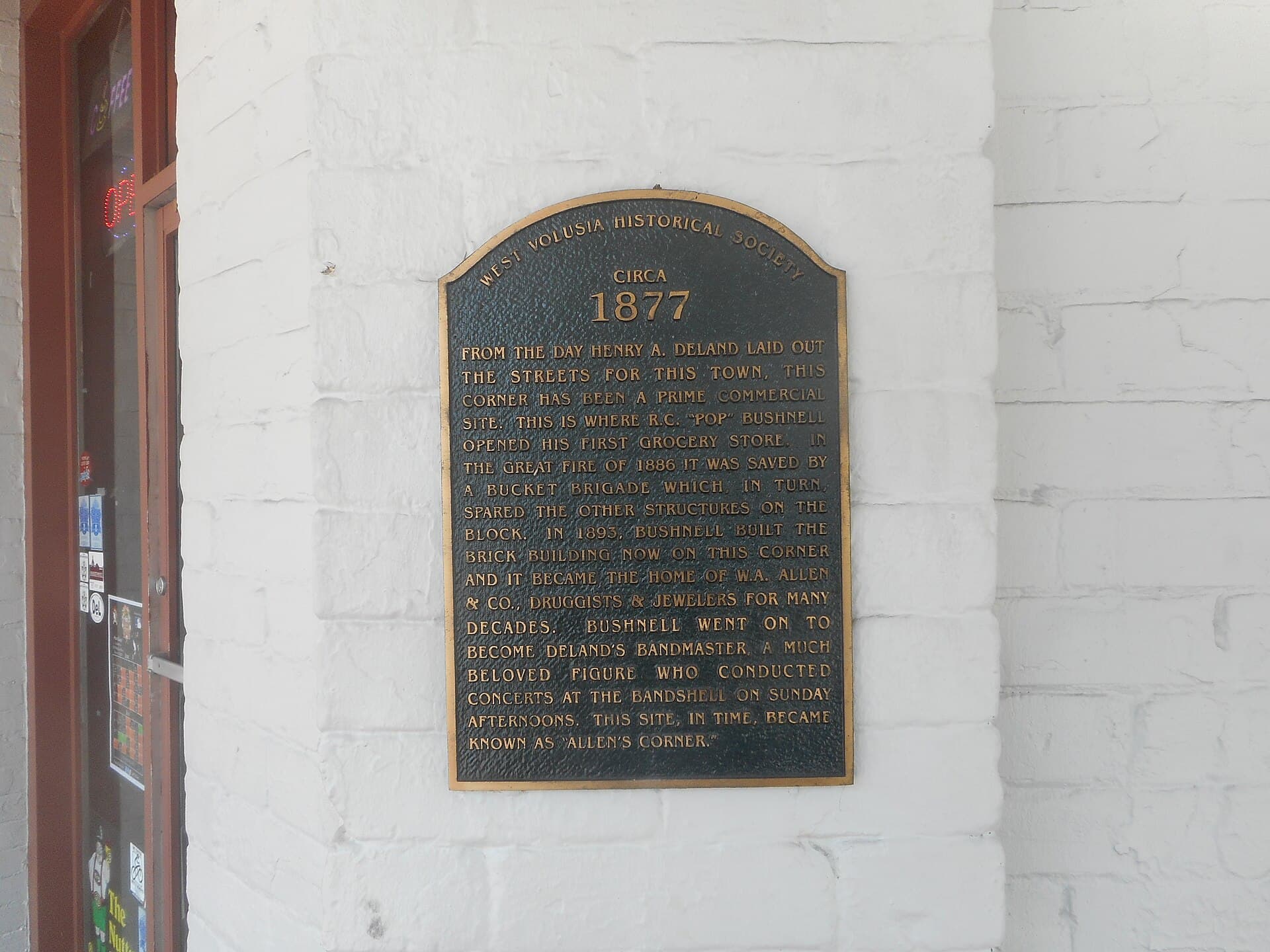
Woodland Boulevard has been DeLand's main street since the town began. It is the north-south spine of downtown, and New York Avenue crosses it east to west. By the mid-1880s the boulevard held stores, a livery and hay business, a furniture store, a lumber office and saloons. Almost all of them were built of pine.
Sometime after midnight on September 27, 1886, a fire broke out at the back of the Wilcox Saloon, on the east side of the 100 block of North Woodland. The story is that a dropped cigar set the sawdust floor alight, but the cause was never confirmed. The fire burned about two blocks between Rich and New York avenues, destroying 22 buildings that held 33 businesses. No one died.
DeLand rebuilt quickly. The town set fire limits that required fireproof brick, and it banned saloons from the central business district, a ban that lasted into the 1930s. Charles A. Miller's building at 100 N. Woodland was back in business by 1887. Many of the rebuilt storefronts used sand-lime brick, which you can still see on buildings downtown.
DeLand joined the National Main Street program in 1985, and the MainStreet DeLand Association has led downtown's revitalization since. On December 23, 1987, the Downtown DeLand Historic District was added to the National Register of Historic Places. It includes the Athens Theatre, the old county courthouse and the Miller-Fish Building.
Sources
Chapter 3 · 1921–today
Behind the Athens Theatre marquee
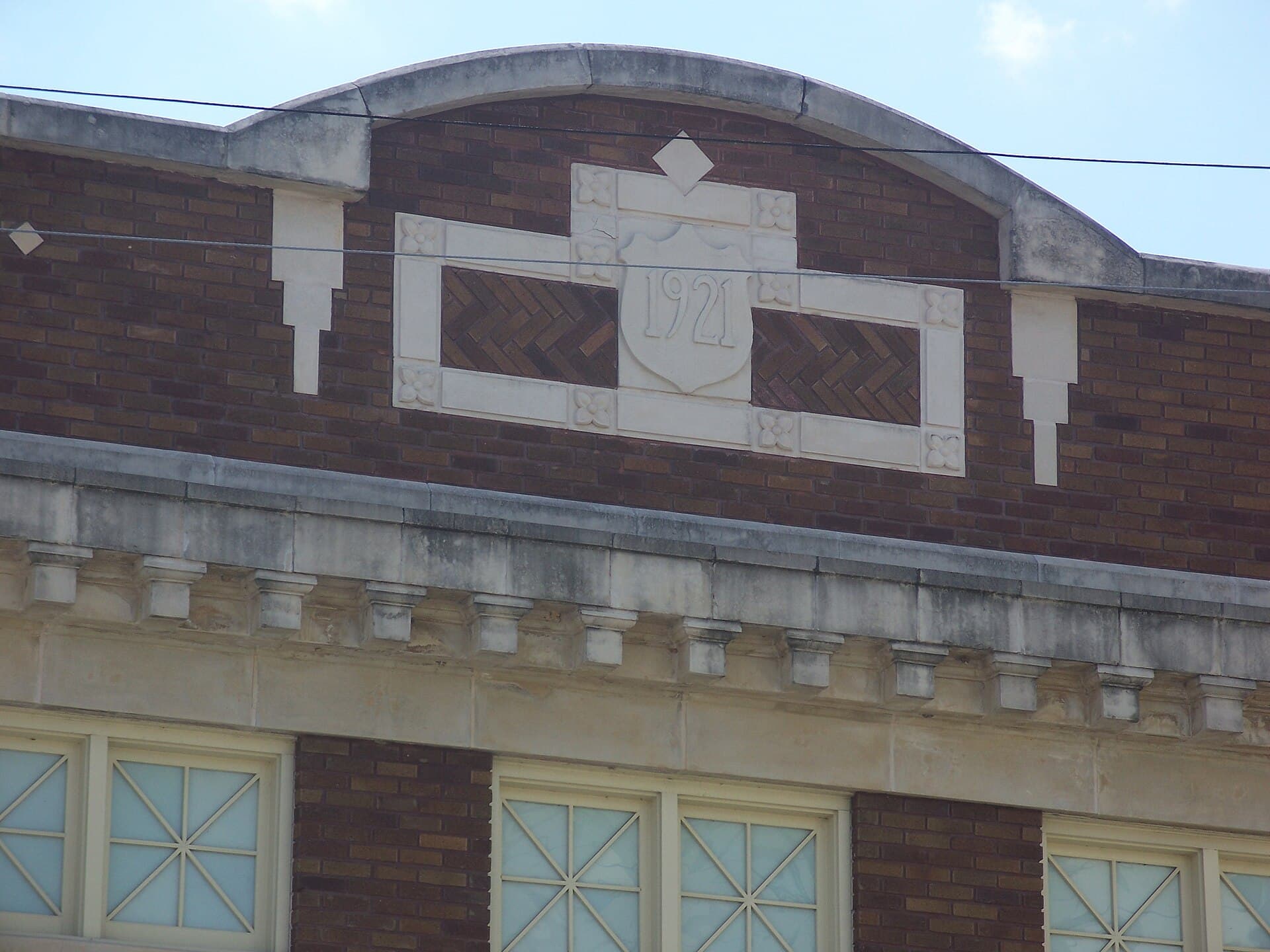
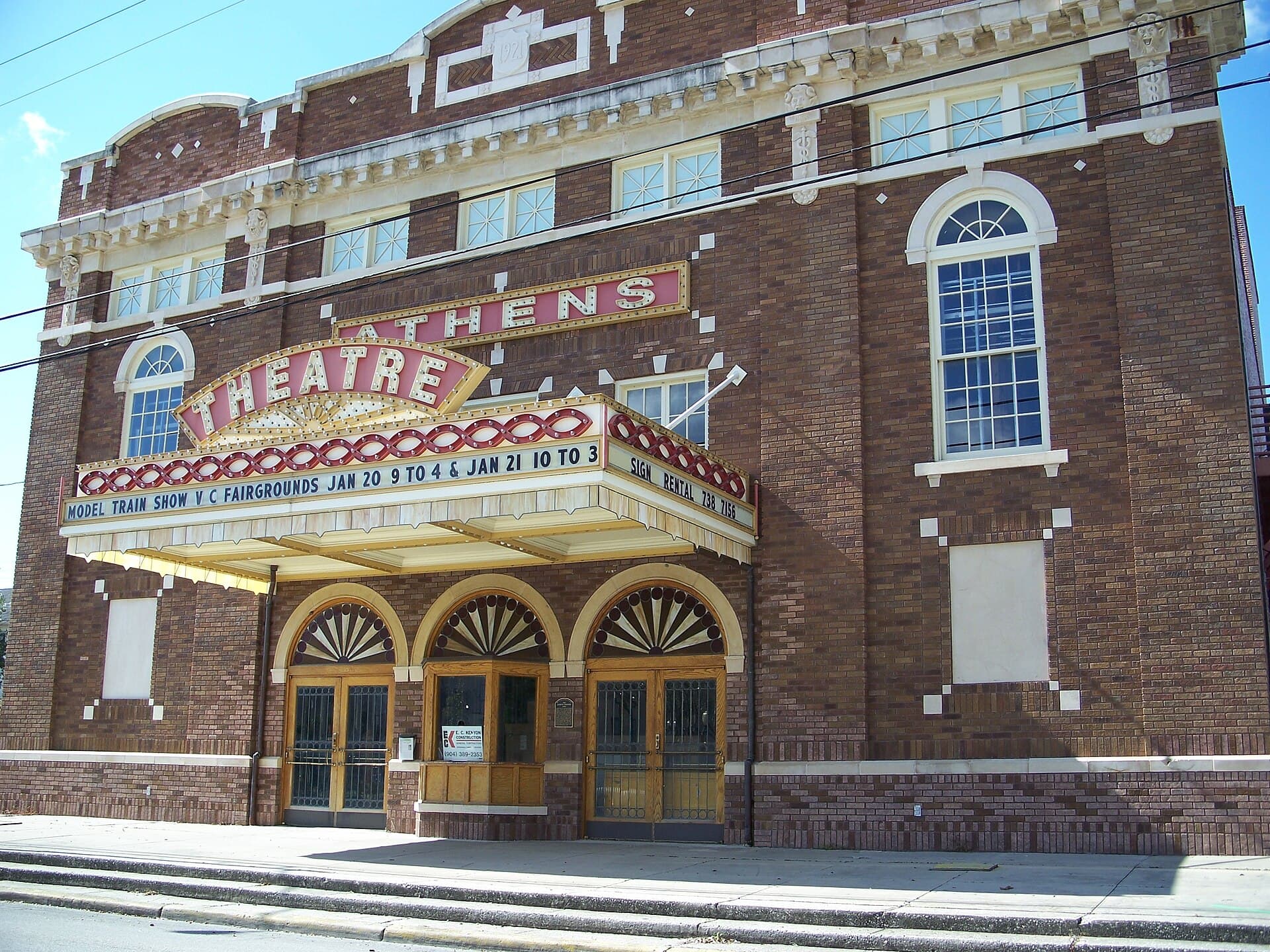
The Athens Theatre at 124 N. Florida Avenue was designed in 1921 by Murray S. King, a well-known Orlando architect, in the Italian Renaissance Revival style. It opened on January 6, 1922. The first night's bill had a silent feature film, a comic play and several vaudeville acts. The name is said to reflect the founders' hope that DeLand would become an "Athens of the South."
Over the decades the Athens went from vaudeville house and silent-movie palace to regular cinema. In the 1950s it was remodeled and its original front was covered with a new facade. Florida State Theatres stopped showing films there in 1975. It later ran as a dinner theater, and by the early 1990s it had closed and fallen into disrepair.
In 1993 the MainStreet DeLand Association led a community effort to save the building. In December 1994, with a matching grant from the Florida Bureau of Historic Preservation, MainStreet bought the theatre for the people of DeLand. By the National Trust's account, that was about 60 days before it was due to be demolished. MainStreet then oversaw the restoration of the exterior.
Sands Theater Center, Inc. took ownership in July 2004 and restored the interior. The 1950s facade came off, and the original brick front, arched windows and marquee were brought back. The Athens reopened on January 6, 2009, its 87th birthday. Today it presents live theatre, concerts and films in the heart of the downtown historic district.
Sources
Chapter 4 · 1883–1900
From DeLand Academy to Stetson University
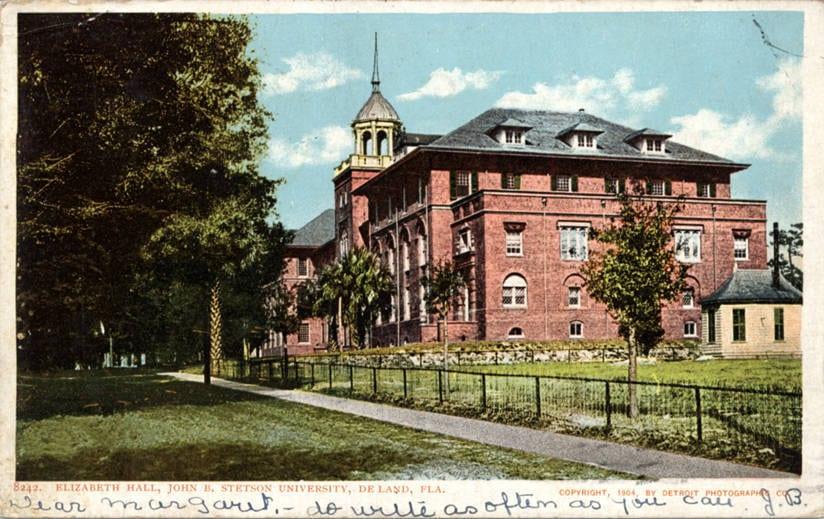
In 1883 Henry DeLand and Dr. John H. Griffith opened DeLand Academy in a rented room of the First Baptist Church. It admitted both men and women. In 1884 the school put up its first building, DeLand Hall. It still stands and is described as the oldest building in Florida in continuous use for higher education.
The school soon outgrew its name. It became DeLand College in 1885. In 1886 Philadelphia hat manufacturer John B. Stetson paid for Stetson Hall, the campus's second building. The school was incorporated as DeLand University in 1887, and Stetson joined its board of trustees.
In 1889 the school was renamed John B. Stetson University in honor of its benefactor, who gave about $1,000,000 between 1886 and 1906. Elizabeth Hall, named for his wife, went up in 1892. It was modeled on Independence Hall in Philadelphia, and its north and south wings were added in 1897.
In 1900 Stetson founded Florida's first law school, which moved to Gulfport in 1954. The university calls itself Florida's first private university. Its 175-acre DeLand campus is listed on the National Register of Historic Places as the Stetson University Campus Historic District.
Sources
Chapter 5 · 1876–1911
Citrus groves and the Great Freeze of 1894–95
Citrus drew DeLand's founder and many of its first families. Henry DeLand pictured the town as a center for oranges, farming and tourism. Settlers from the North planted groves on the ridge land around town and hoped for quick returns. The freeze of 1885–86 was a warning: it killed that year's fruit but spared the trees, and the local economy recovered.
The winter of 1894–95 was far worse. On December 29, 1894, the temperature in DeLand fell to 15°F. Leaves blackened, but the trunks survived. A warm January brought out new growth. Then a second freeze arrived on February 8, 1895, and the budding trees were "killed to the ground." Helen DeLand, Henry's daughter, called the two freezes together "staggering."
Across Florida, the freeze wiped out growers and investors. Some gave up and went back north, and others moved their groves farther south. Henry DeLand had personally guaranteed other people's investments in the area, and he felt bound to honor those guarantees. By 1896 he had sold his property in Florida and Fairport. He returned to Fairport to work, and he died in 1908 with little money left.
Florida's citrus crop took years to recover. Growers in DeLand kept experimenting. Lue Gim Gong, a horticulturist who lived and worked in DeLand, developed a late-ripening, frost-tolerant orange. In 1911 the American Pomological Society gave it the Silver Wilder Medal, the first such award for a citrus fruit.
Sources
Chapter 6 · 1888–today
How DeLand became the county seat
Volusia County's first seat of government was Enterprise, on Lake Monroe. Less than two years after the 1886 fire, DeLand won a countywide election to move the county seat, and in 1888 DeLand became the seat of Volusia County. The vote was contentious, and Enterprise, a town of about 800 people at the time, lost its role.
Henry A. DeLand donated land for a wooden courthouse on the site where the historic courthouse stands today. It was built at no cost to the county, because DeLand, John B. Stetson and Mayor Fred S. Goodrich pledged a $15,000 bond. Sources date its completion to 1889 or 1890.
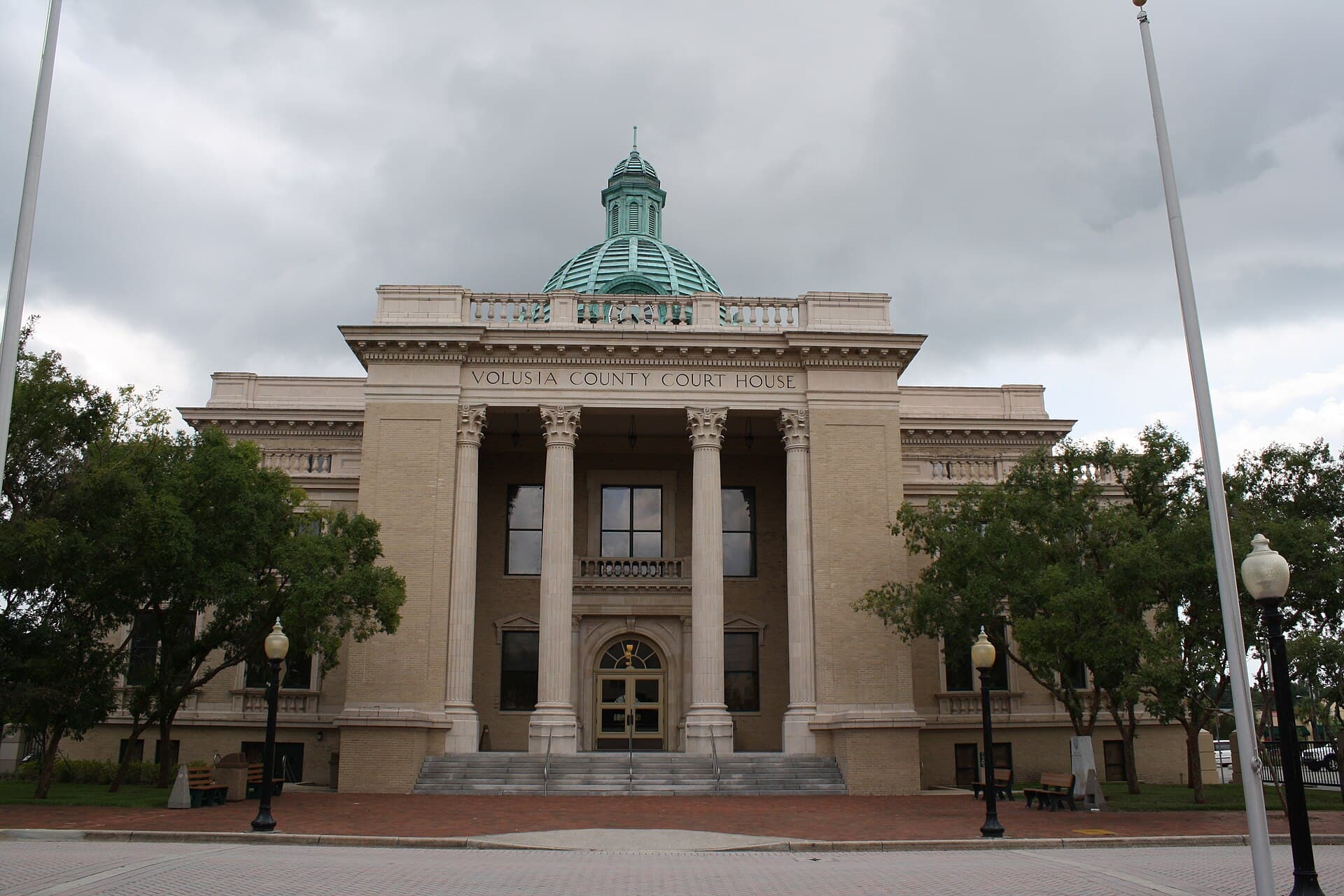
As the county grew, it needed a larger building. Construction of a Neoclassical courthouse began in 1927 and finished in 1929, at a cost of $500,000. It has fluted Corinthian columns, marble staircases, a copper-clad dome and a stained-glass interior cupola. More than 3,000 people came to its dedication, which featured a barbecue, concerts and circus performers.
The building served the courts for more than 70 years, until 2001. It was renovated in 2005 and now houses county offices and public artworks. It was listed on the National Register in 1987 as part of the Downtown DeLand Historic District, and it remains one of the best-known landmarks on DeLand's skyline.
Sources
Chapter 7 · 1876–present
The "Athens of Florida" — A Nickname With a Mission
When Henry DeLand called his new town the Athens of Florida, he was making a promise as much as a nickname. He wanted a place of culture, education, and beauty on the model of ancient Athens, and he ordered his priorities to match: a school before a church, a college before a courthouse, and the modern infrastructure to sustain both. It was an audacious vision for a frontier settlement carved out of pine scrub and persimmon groves.
The substance behind the slogan is what made it stick. DeLand founded Florida's first private college — the DeLand Academy of 1883, which became Stetson University — and the town became an early adopter of electric lighting, frequently credited with some of the first incandescent streetlights in the state. Broad, tree-lined Woodland Boulevard and a downtown of handsome brick buildings gave the ideal a physical form residents could walk through.
More than a century and a half later, the name still holds. It appears on the Athens Theatre marquee, in the heritage archives, and in the way DeLand talks about itself — a small city that has always believed its worth is measured in learning, art, and civic pride. Few Florida nicknames have stayed so faithful to their founder's original intent.
Sources
- Historic DeLand | The Athens of Florida — Heritage Archive
- The Athens of Florida: DeLand — Floridiana Magazine
Some details in this chapter are still being verified.
Chapter 8 · 1886–present
The DeLand House Museum & West Volusia Historical Society
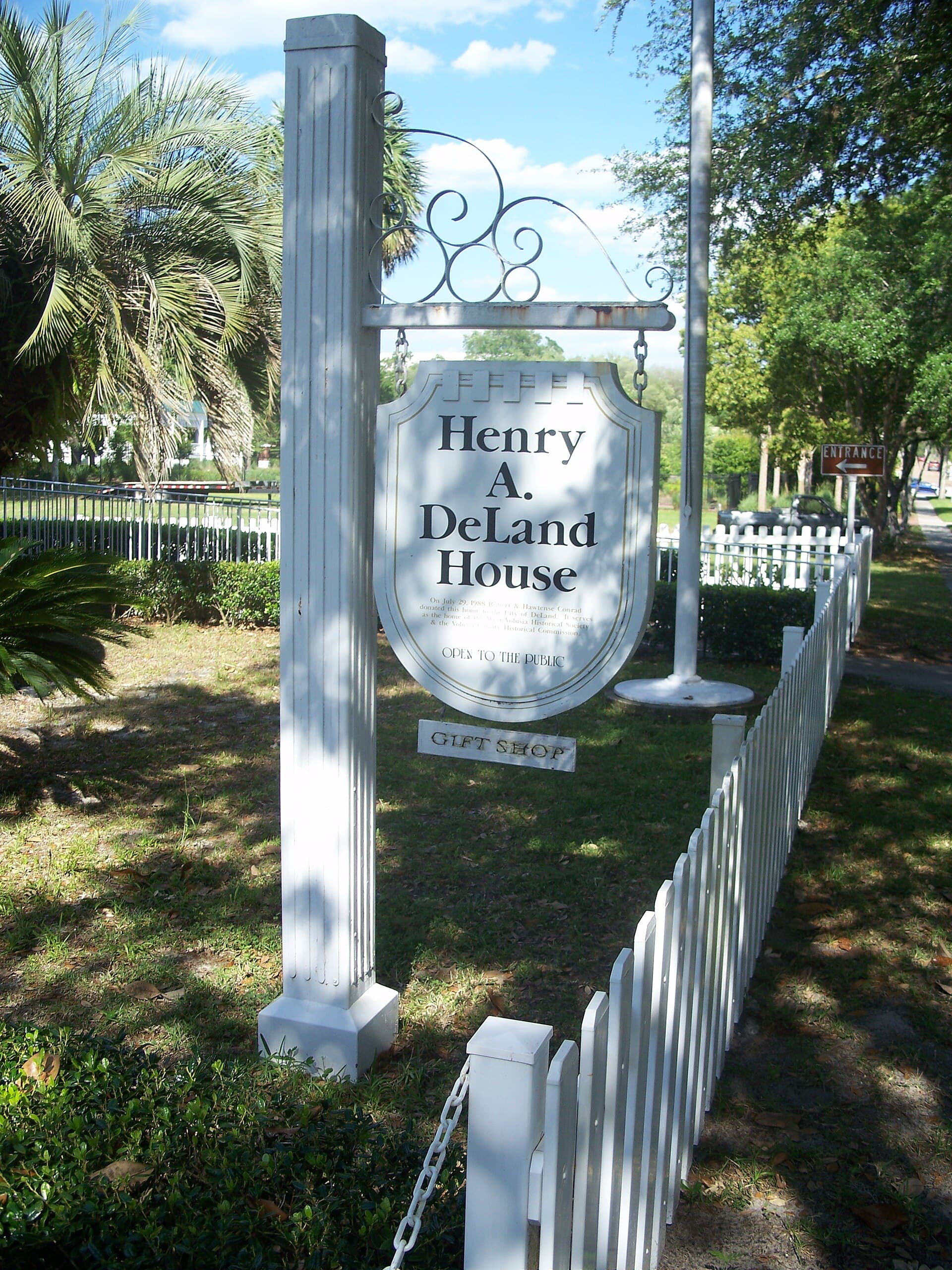
The best place to meet Henry DeLand is inside the house he built. Constructed in 1886, the Henry A. DeLand House passed through many owners over the following century before being donated to the City of DeLand in 1988. What happened next is a story of community devotion as much as bricks and mortar.
The stewards were the West Volusia Historical Society, founded in 1973 as an all-volunteer nonprofit dedicated to researching, preserving, and sharing the history of West Volusia County. Led by their first director, the beloved local historian Bill Dreggors, volunteers pored over the aging house, and with support from the city and community donations they opened it to the public as the DeLand House Museum in 1990. The society added the Conrad Research Center in 1997 to house its growing archive.
At 137 West Michigan Avenue, the museum interprets the life of the founder and the broader history of the region, while the society also curates exhibits at the DeLand Memorial Hospital and Veterans Museum. After a pandemic-era closure, a much-needed restoration was completed in June 2024, ensuring that the founder's home will keep telling the city's story for another generation.
Chapter 9 · 1994–present
African American Museum of the Arts & Historic Spring Hill
Not every chapter of DeLand's story was written on Woodland Boulevard. Spring Hill, the city's historic African American neighborhood, has its own deep roots and its own institutions — chief among them the African American Museum of the Arts, founded in 1994 by Irene and Maxwell Johnson. Located at 325 South Clara Avenue, the museum sits squarely in the center of the community it serves.
The AAMA is the only museum in the area devoted primarily to African American and Caribbean cultures and art. Its permanent collection holds more than 150 artifacts, including sculptures and masks gathered from countries across Africa, offering visitors a window onto a heritage that is often left out of small-town Southern histories. From a modest leased space, it has grown into a cultural anchor.
The museum's reach extends well beyond its walls. Working alongside partners such as Stetson University, the West Volusia Historical Society, Great Union First Baptist Church, and Spring Hill residents and business owners, the AAMA helps sponsor the DeLand Black Heritage Trail — a guide to the landmarks and stories of the Black community. In doing so it ensures that the Athens of Florida remembers all of its citizens, not only its founders.
Chapter 10 · 1985–present
Historic Downtown & MainStreet DeLand
DeLand's downtown didn't survive the age of the shopping mall by accident — it survived because the community organized to save it. When Florida launched its Main Street program in 1985, DeLand was among the very first five communities designated, betting early on preservation-based economic development at a time when many small-town cores were emptying out.
The bet paid off spectacularly. In 1997 the National Trust for Historic Preservation named DeLand a recipient of the Great American Main Street Award — the first such honor in the state of Florida. Two decades later, in 2017, MainStreet DeLand won the national "America's Main Streets" contest, making DeLand the only community in the country to have claimed both of those distinctions.
Today the MainStreet DeLand Association operates as an accredited Main Street America program, part of a national network of more than 1,200 neighborhoods committed to building stronger communities through the careful stewardship of historic places. The result is a downtown of restored brick storefronts, independent shops, galleries, and restaurants — living proof that the Athens of Florida's civic pride is not just history, but a working strategy.
Sources
Chapter 12 · 1894–present
Cassadaga Spiritualist Camp
A few miles south of DeLand, tucked among the pine hills near Lake Helen, lies one of Florida's most unusual communities: Cassadaga, a village of mediums and mystics often called the Psychic Capital of the World. Its origins trace to George P. Colby, a traveling medium who, the story goes, was guided south in the 1870s by a spirit named Seneca to find "the high pine hills overlooking silvery lakes."
Colby found those hills in Volusia County, and on December 18, 1894, he and several fellow Spiritualists secured a charter for the Southern Cassadaga Spiritualist Camp Meeting Association. A few weeks later, on January 3, 1895, Colby deeded thirty-five acres of his homestead to the new association, formally establishing the camp. They named it after Cassadaga Lake, New York, already a center of Spiritualist activity, tying their Florida settlement to a broader nineteenth-century movement.
The camp grew to roughly fifty-seven acres and endures today as a working Spiritualist community of certified mediums, healers, and historic cottages. Added to the National Register of Historic Places in 1991, Cassadaga draws curious visitors from around the world and remains one of the most distinctive threads in the tapestry of West Volusia history — a quiet, otherworldly neighbor to the Athens of Florida.
Chapter 13 · 1926–2017
Bill Dreggors, "Mr. DeLand"
Every town that keeps its history alive has someone who makes it their life's work. In DeLand, that someone was Bill Dreggors — known to nearly everyone simply as "Mr. DeLand." A local through and through, he attended DeLand High School, served in the U.S. Navy, and worked for Florida Power for forty-two years before retiring into a second career that would define his legacy.
That second career was folk history. Dreggors became president of the West Volusia Historical Society in January 1975 and, when the group briefly disbanded, kept its mission alive almost single-handedly, helping to revive it in the 1980s. He gathered the bulk of the photographs that make up the society's collection and had a hand in restoring the Athens Theatre, the DeLand Memorial Hospital, the DeLand House, and DeBary Hall.
Over the years he created more than 120 programs, weaving authenticated facts and colorful folk stories about early Volusia County and Florida into presentations that made the past feel present. Born June 30, 1926, he died February 3, 2017, at the age of ninety — but the archives he saved and the landmarks he rescued keep "Mr. DeLand" woven into the city he loved.
Sources
Know something we should add or correct? Tell us.